
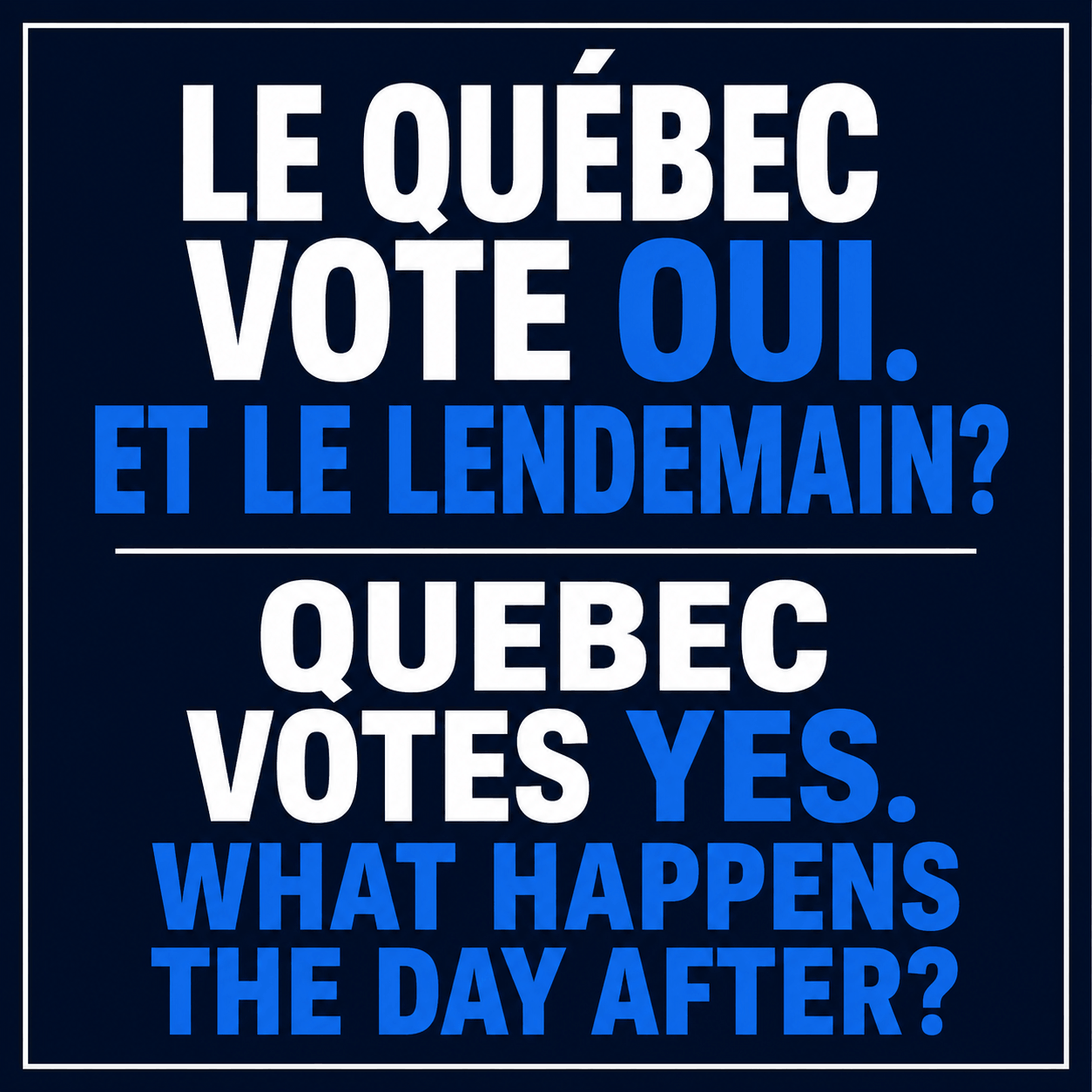
I have watched Paul St-Pierre Plamondon closely for three years. His decision to postpone a referendum has finally made me see the sovereignty debate differently.
PSPP says Quebec needs a more “serene” environment and that the current upheaval in American politics could interfere with such an important decision. But if Quebecers are deciding whether to leave Canada, why should the identity of the President of the United States determine when we vote?
That question stopped me.
For decades, we have talked about sovereignty as though there were two players: Quebec and Canada.
Perhaps there are three. And perhaps the third player could eventually matter more than either of the first two. The real danger may not be the day Quebec votes Yes. It will be the day after.
A newly independent Quebec would immediately face enormous decisions. Trade. Borders. Debt. Investment. Defense. And money.
What currency would Quebec use? The Canadian dollar? A new Quebec currency? Or the American dollar?
Let’s assume Canada and Quebec cannot agree on continuing to share the Canadian dollar. Imagine Washington offering the simplest possible solution: use the U.S. dollar during the transition. No need to create a currency immediately. Businesses keep operating. Markets remain stable. Quebecers have money they know and trust.
It would be tempting, possibly impossible to refuse. And that is precisely what worries me.
Quebecers begin getting paid in American dollars. They buy in American dollars. They save in American dollars. Businesses price in American dollars. Investments increasingly follow the American economy.
At first, it is convenient. Then it becomes normal. Eventually, dependence doesn’t feel like dependence anymore.
And the question changes. Why remain a small independent country beside the United States and Canada when so much of our economic life is already tied to the United States?
That is not an accusation that Washington has a secret plan to annex Quebec. It doesn’t need one. History should be enough to make us think. The United States expanded across the continent through purchases, treaties, war and annexation. The methods changed. American interests remained. And American presidents change too.
Which brings me back to PSPP. He has already told us that the man occupying the White House matters enough to change the timing of his referendum.
Think about what that means. Today, Quebec negotiates with Washington with the political, economic and international weight of Canada behind us.
The day after independence, that changes.
Now put two people across the table from one another. Paul St-Pierre Plamondon. And the President of the United States.
One represents a new country of roughly nine million people trying to establish itself. The other represents the most powerful country on Earth and Quebec’s largest foreign economic relationship.
Who needs whom more?
That is where PSPP’s postponement became a turning point for me. If an American president can make him change his plans while Quebec is still part of Canada, what happens when he faces that president as the leader of a new country suddenly on its own?
The United States would hold almost every card. PSPP would hold almost none.
But this is no longer only about PSPP.
For decades, Quebecers have been asked whether leaving Canada would finally make Quebec sovereign. Perhaps we have been so consumed by that question that we have neglected another one.
What happens to that sovereignty the day after we get it?
Leaving one federation does not guarantee that Quebec remains free of the gravitational pull of another, much larger neighbor. And if economic necessity gradually pulled an independent Quebec closer and closer to the United States, we could confront an extraordinary irony.
Quebec could leave Canada in pursuit of greater sovereignty only to discover that independence had made it more dependent on the United States.
That possibility changes the referendum for me.
For three years, I have been watching PSPP. For much longer, Quebec has been watching the referendum.
Perhaps we have all been watching the wrong day.
The day that worries me now is the day after.
AJH