
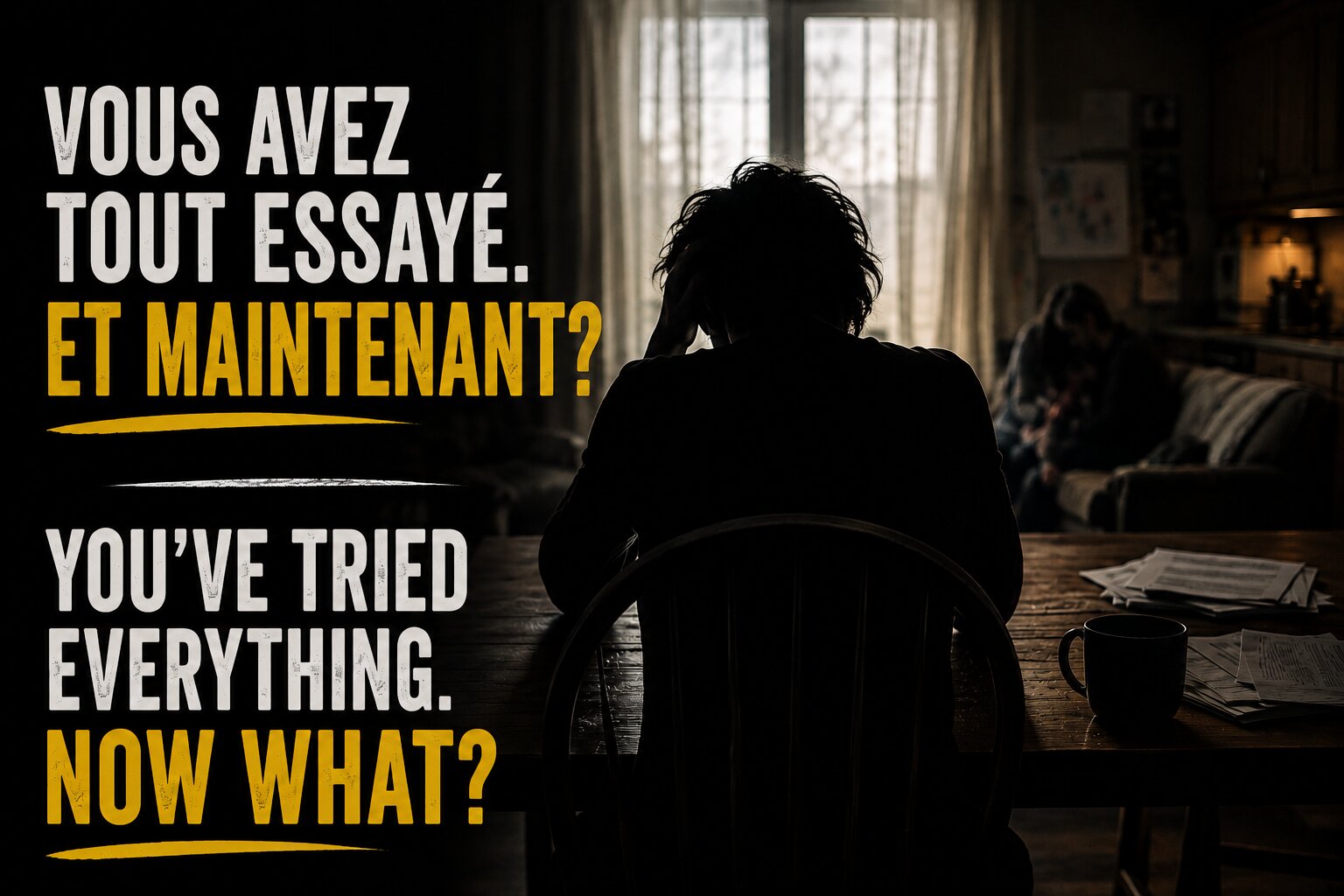
Your child is struggling. Your spouse’s anxiety is taking over. A parent is becoming impossible to manage. An employee is falling apart.
You’ve talked. You’ve worried. You’ve tried to help. And you’ve hit a brick wall.
You don’t know what to do. And increasingly, neither do the teachers, physicians, hospitals, police and other professionals you turn to.
Why is this happening to so many of us, in so many different places, at the same time?
I think we’ve been asking the wrong question.
Read what I believe we have failed to see:
HOW MENTALLY HEALTHY ARE WE?
Before We Appoint Someone to Take Care of Our Mental Health, Perhaps We Should Find Out What Is Actually Happening to Us
I returned once again to the subject of mental health for a reason I hadn’t expected. There is now talk of making mental health a major political priority, perhaps even appointing a Minister of Mental Health. Presumably that minister would have a mandate, a department, experts, programs and, eventually, a considerable amount of public money to spend.
Maybe that’s exactly what we need. But something about it bothers me.
Before Quebec appoints a Minister of Mental Health, perhaps we should decide whether we are appointing a minister responsible for treating mental illness, or someone responsible for understanding and dealing with the mental health of an entire population.
They are not the same job.
And even if we never appoint such a minister, the question doesn’t disappear. Are we, as a people, mentally healthy?
I have been uneasy about that question for years. Not because I believe everyone is mentally ill. We aren’t. And not because every social problem is a mental-health problem. It isn’t. My unease comes from watching what seems to be happening all around us.
Something Is Happening
Are we more anxious than our parents were? Are our children more anxious than we were? Are we more anxious at work, at home and in public places?
Why are so many young people struggling? Why are boys disengaging from school? Why do teachers increasingly find themselves dealing with problems that have little to do with teaching? Why do employers and employees talk so much about stress, burnout and psychological safety? Why do families seem to be absorbing pressures that once would have been considered extraordinary? Why do so many of us think twice before confronting a stranger?
Yes, we calculate more. We avoid more. The driver who nearly hits us. The stranger behaving aggressively. The neighbor who has gone too far. The employee or colleague whose behavior is becoming disturbing.
Don’t honk. Don’t stare. Don’t argue. Don’t get involved. Mind your own business. Maybe that’s simply good judgment. But what interests me is that so many of us appear to be making these calculations at all.
We hear about wars, shootings, road rage, fraud, cybercrime, addiction, family breakdown, homelessness, political anger and people exploding over disagreements that once might have ended with an argument.
At the same time, ordinary families are dealing with the cost of food, housing and almost everything else. Parents worry about their children. Adult children worry about aging parents. People worry about their jobs, their savings and whether the institutions they have always counted upon will still be there when they need them.
These are different problems. They have different causes and will require different solutions.
But they accumulate inside the same human being. And perhaps that is something we haven’t been measuring very well.
We Measure Mental Illness
Do We Measure Mental Health?
We know how to count the consequences. We count people diagnosed with mental illnesses. We count emergency-room visits. We measure suicide, addiction, homelessness, school dropout rates, absenteeism, crime and waiting lists. Each number becomes somebody’s responsibility.
Education deals with schools. Health deals with illness. Police deal with crime. Social services deal with families. Employers deal with workplaces. Municipalities deal with homelessness. Another department deals with addiction.
We divide human problems into categories because governments and institutions have to organize themselves somehow.
But human beings don’t experience government departments. They experience their lives.
A child struggling at school doesn’t leave family anxiety at the classroom door. An exhausted employee doesn’t stop being a worried parent when arriving at work. A person frightened about money, an aging parent, a troubled child or an unstable spouse carries that anxiety wherever he or she goes.
So, perhaps we have become very good at measuring individual problems while becoming less capable of seeing what they may collectively be doing to us. What if some of the numbers we treat separately also telling us something about the mental health of the population itself?
I don’t know for sure, but I have a pretty good idea. Nonetheless, I think it’s time we asked.
The Sleeping Pill
For years I wrote about deinstitutionalization. I believe Quebec closed its expensive psychiatric institutions primarily to save money, then sold us “care in the community” as a better and more humane alternative. We bought it. I believe we were sold a lie. But I have also come to realize that even the expression deinstitutionalization may be part of the problem.
The word practically puts people to sleep. It sounds like health-care policy. Something for psychiatrists, hospitals, social workers and governments to worry about. Not me.
“Care in the community” may be even more reassuring and more misleading, because “the community” sounds like everyone while making no one responsible. But who is the community? The family? The physician? The social worker? The police officer? The emergency department? The school? The neighbor?
Everybody became responsible for something. Nobody was necessarily responsible for the result. And perhaps the greatest accomplishment of the expression “care in the community” was psychological. It allowed the rest of us to believe that somebody, somewhere, was taking care of the problem.
The community would handle it. We could go home and watch TV.
Another Sleeping Pill?
That is what worries me about a Minister of Mental Health. Not because I oppose one. My concern is almost the opposite.
A minister may be appointed. A department may be created. Experts will be consulted. Programs will be announced. Money will be spent. Governments will tell us they have made mental health a priority.
And we may feel reassured. Someone is in charge. But in charge of what?
If we mean treating people suffering from mental illness, say so. It is an enormous responsibility and one that desperately needs attention. But don’t confuse treating mental illness with understanding the mental health of a population.
A population can be experiencing increasing anxiety, declining trust, social isolation, family pressure, workplace stress, fear and uncertainty without most of its citizens suffering from a diagnosable psychiatric illness.
That doesn’t necessarily make the population mentally ill. But does it make us mentally healthy?
Look at the Children
If I wanted to know what was happening to the mental health of a society, I’m not sure I would begin in a psychiatric hospital.
I might begin in a school. Children have an extraordinary way of showing us the consequences of the world adults have created.
Why are some struggling so much? Why are boys increasingly disengaging from education? Why are teachers being asked to manage behavioral and psychological problems in addition to teaching? Why are parents worried about things their own parents rarely discussed?
We can debate every one of those questions. We should.
Maybe education has changed. Maybe families have changed. Technology certainly has. Social media has. The labor market has. Expectations have changed. The world children are preparing to enter has changed.
But that is precisely my point. Their psychological environment has changed. So has ours. And perhaps we should become much more interested in what that is doing to us.
Fear Is Part of Mental Health Too
Something else has changed in ways that are difficult to measure. Trust.
Do you feel as comfortable confronting a stranger as you once did? Do you hesitate before honking at someone who cuts you off? Do you avoid an argument because you don’t know how the other person might react? Do you tell your children to walk away rather than get involved? Do you look around differently in certain public places? Perhaps.
But millions of small calculations like these determine how people experience ordinary life. When enough people begin wondering whether another human being represents an unpredictable risk, something happens that won’t necessarily appear in mental-health statistics.
People withdraw. They become cautious. They trust less. And eventually we begin adapting our behavior to our anxiety. That should interest anyone claiming responsibility for the mental health of a population.
What Are We Actually Trying to Fix?
This is why I don’t want another enormous conversation about mental-health programs to begin with the programs. I want it to begin with us.
How are we doing?
Not simply how many psychiatrists do we have? Not only how long is the waiting list? Not simply how many hospital beds, psychologists, social workers or community programs do we need?
Those questions matter enormously. But they come later. First, I want to know what is happening to the people those systems are supposed to serve. Are we more anxious? Are our children? Are we more isolated despite being more connected? Are families under greater psychological pressure? Are workplaces becoming more difficult human environments? Are people becoming more afraid of one another? Are we losing confidence that institutions can help us before something goes terribly wrong? And if several of these things are happening simultaneously, are they entirely separate problems?
Or are they telling us something larger about ourselves?
The Conversation I Want
I don’t pretend to know all the answers. In fact, that’s the reason I’m writing this.
I would like this conversation to take place around kitchen tables. In schools and universities. In workplaces and boardrooms. Among CEOs, teachers, physicians, psychologists, social workers, police officers, parents, and everyone entrusted with responsibility for the well-being of others.
I want it taking place inside governments. And perhaps even more importantly, inside the political parties asking us to make them the next government.
Don’t begin by telling us how much money you intend to spend. Don’t begin by announcing another program. And please don’t reassure us that somebody else is going to take care of it.
Start by asking, what I think may be the most important mental-health question we have avoided, what is happening to us? Maybe the answer will reassure us. Maybe it won’t.
But if we’re serious enough about mental health to consider putting a minister in charge of it, surely we’re serious enough to ask whether we even understand what mental health means beyond mental illness.
Because mental health isn’t something that belongs only to the person experiencing a psychiatric crisis.
It belongs to the child sitting in a classroom. The teacher standing in front of that child. The parent waiting at home. The employee going to work. The employer trying to manage that workplace. The police officer approaching a stranger. The elderly person afraid of being defrauded. And the millions of ordinary people quietly adjusting their behavior to a world that sometimes feels less predictable than it once did.
This is not somebody else’s mental health. It is ours. So, before we appoint someone to take care of our mental health, shouldn’t we first find out:
How mentally healthy are we actually?
AJH