
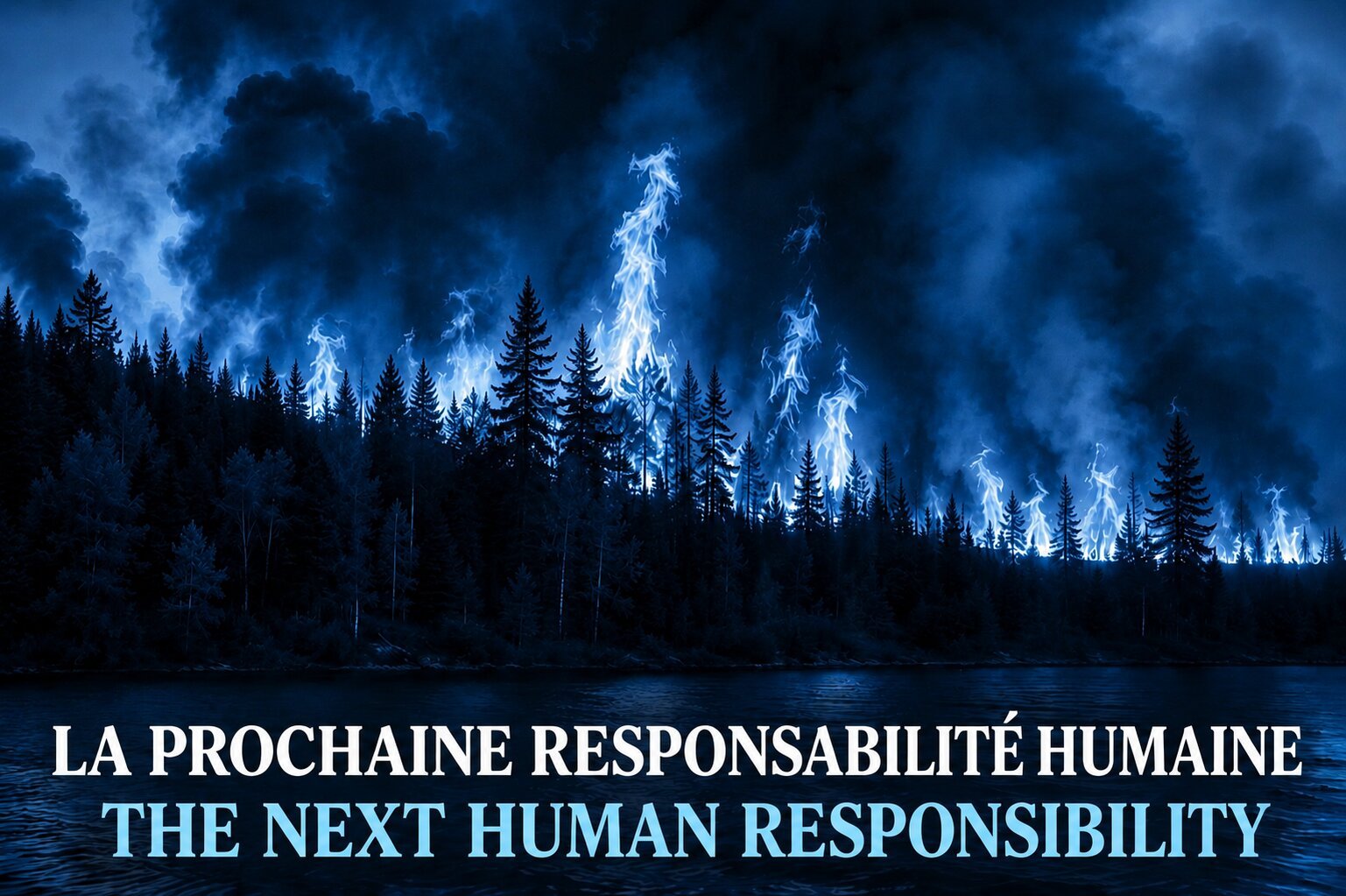
Last week I argued that Canada is fighting tomorrow’s forest fires with yesterday’s strategy. The real problem was never the fires themselves. It was our refusal to recognize that the climate producing them has already changed.
This article argues that Canada is preparing for wildfires the way it prepared for yesterday’s climate instead of tomorrow’s. Once communities are evacuating, the first battle has already been lost. The real challenge is not simply responding to disasters but anticipating them years in advance.
Climate change is no longer simply an environmental issue. It increasingly affects mortgages, food production, drinking water, electricity, public finances, insurance and, ultimately, our confidence that tomorrow will look much like today.
For decades, humanity has focused on preventing climate change. That effort remains essential, but it has not stopped the planet from warming. The challenge has changed with it. Our next task is not simply to reduce emissions. It is to keep the way we live possible in a climate that has already changed. That will require a scientific, technological and institutional transformation unlike anything we have attempted before.
If that possibility seems worth considering, keep reading. Everything that follows begins with a simple question.
For twelve thousand years, humanity asked only one question: How do we adapt to nature? What if the twenty-first century forces us to ask a different one?
Throughout that long history, civilization survived because nature changed slowly enough for people to adapt. We migrated. We changed how we lived. We learned to farm different lands. We rebuilt after floods, droughts and fires. Human history is, in many ways, the history of adaptation.
What if we are becoming the first civilization forced to ask a different question? Not whether we can adapt. But whether adaptation alone will still be enough.
I spent a few years working alongside actuaries in the insurance industry. Their profession exists for one reason: estimating future risk as accurately as possible. Insurance pricing rests on a simple assumption: tomorrow will statistically resemble yesterday. Historical experience allows actuaries to estimate future risk. That is how homes are insured, businesses financed, mortgages approved and communities built.
Actuaries don’t create risk. They measure it. If the people whose profession is predicting tomorrow conclude that tomorrow no longer resembles yesterday, the rest of us should pay attention. Which raises another question: What happens when history becomes a poor predictor of the future?
For insurers, it is a business question. For the rest of us, it is about whether the ordinary life we’ve built can continue. Can we still live where we choose? Raise our children in safe neighborhoods? Count on clean water, reliable electricity, functioning schools, emergency services and the rule of law? That is civilization: the quiet confidence that these things will still be there tomorrow.
Imagine insurance companies concluding that certain regions have become too risky to insure at an affordable cost. Banks reconsider mortgages. Property values begin changing. Families discover that their homes, often their largest investment, can no longer be economically protected. The day your house, business or employer can no longer be insured, climate change stops being a scientific debate. It becomes your mortgage. Your retirement. Your children’s inheritance.
Protection disappears not because people no longer need it, but because the risks become too expensive to insure. Insurance companies are not charities; they must remain financially viable. When they withdraw from certain markets, they send society an economic warning. The people who measure tomorrow for a living are often the first to recognize that the future can no longer be predicted by the past.
Modern economies depend on insurable risk. Banks lend, businesses invest and families buy homes because catastrophic losses can often be insured. When that confidence begins to disappear, the consequences spread far beyond the insurance industry.
Once that confidence erodes, every system built upon it weakens. Food, water, electricity and supply chains become less predictable. Governments spend more responding to disasters and less preparing for the future. Everything becomes more expensive. Everything becomes less certain.
Perhaps the greatest illusion of all is believing that civilization is defined by its cities, highways or technology. It isn’t. Civilization is the quiet confidence that tomorrow will resemble today. That your children can safely go to school. That drinking water will come from the tap. That the lights will turn on. That an ambulance will arrive when you call. That the police will enforce the law. That your home, your savings and your rights remain protected. Climate change increasingly challenges the predictability upon which those expectations depend.
For decades, psychologists have relied on Abraham Maslow’s hierarchy of human needs to explain how people develop. At the base of his pyramid are the essentials of life: food, water, shelter and safety. Only after those needs are reasonably secure can people pursue belonging, personal achievement and the opportunity to become the best version of themselves.
Maslow’s model quietly assumes something almost everyone has taken for granted: civilization will continue providing those fundamental needs. But what if it begins struggling to do so? What if climate change disrupts every level of Maslow’s hierarchy? Food. Water. Shelter. Safety. Community. Employment. Economic confidence. Mental well-being. Even our ability to imagine a stable future.
The greatest challenge of the twenty-first century may not be helping humanity climb Maslow’s pyramid. It may be ensuring that the foundation beneath it remains secure.
History suggests that humanity answers great challenges with great transformations. The Agricultural Revolution changed how we produced food. The Scientific Revolution changed how we understood nature. The Industrial Revolution multiplied human productivity. The Digital Revolution connected billions of people. Artificial intelligence is now transforming how knowledge is created and used.
Each revolution created professions that had never existed. Each required new industries, new institutions and new ways of thinking. The next revolution may be unlike any before. Not because it will transform how we communicate or travel, but because it may transform humanity’s relationship with nature itself. No one knows what the eventual solutions will look like.
They may involve advances in atmospheric science, artificial intelligence, materials science, energy systems or entirely new disciplines. Some ideas will fail. Others will seem impossible until science and engineering make them practical. That has been true of every technological revolution.
The question is not whether one particular solution succeeds. It is whether we begin treating planetary stability as one of its defining scientific and engineering challenges.
If that day comes, future generations may aspire to become planetary systems engineers, climate architects, atmospheric restoration scientists, global resilience planners, planetary risk analysts or specialists in professions that today have no names because the problems they will solve have not yet fully arrived.
Every generation eventually confronts problems that previous generations considered impossible to solve. History shows that yesterday’s impossibilities often become tomorrow’s engineering projects.
The planet our children inherit will almost certainly not be governed by the weather patterns that shaped our past. It will require new sciences, new industries, new professions, new international institutions and a level of global cooperation unlike anything humanity has ever attempted.
Humanity has repeatedly transformed itself when confronted with challenges that exceeded existing knowledge. This challenge may require the greatest transformation of all. Not because we seek to conquer nature, but because adaptation alone may no longer be enough.
For twelve thousand years, civilization adapted to nature. The twenty-first century may become the first in which civilization deliberately begins managing parts of nature itself, not to conquer nature, but to help keep the conditions that allow ordinary human life within reach. If that day comes, our children may inherit more than a different planet. They may inherit a different understanding of humanity’s place within it. A civilizational singularity: the moment humanity’s relationship with nature fundamentally changed, not because we finally controlled the planet, but because our future increasingly depended on deliberately shaping the environmental conditions that allow civilization to endure.
AJH