
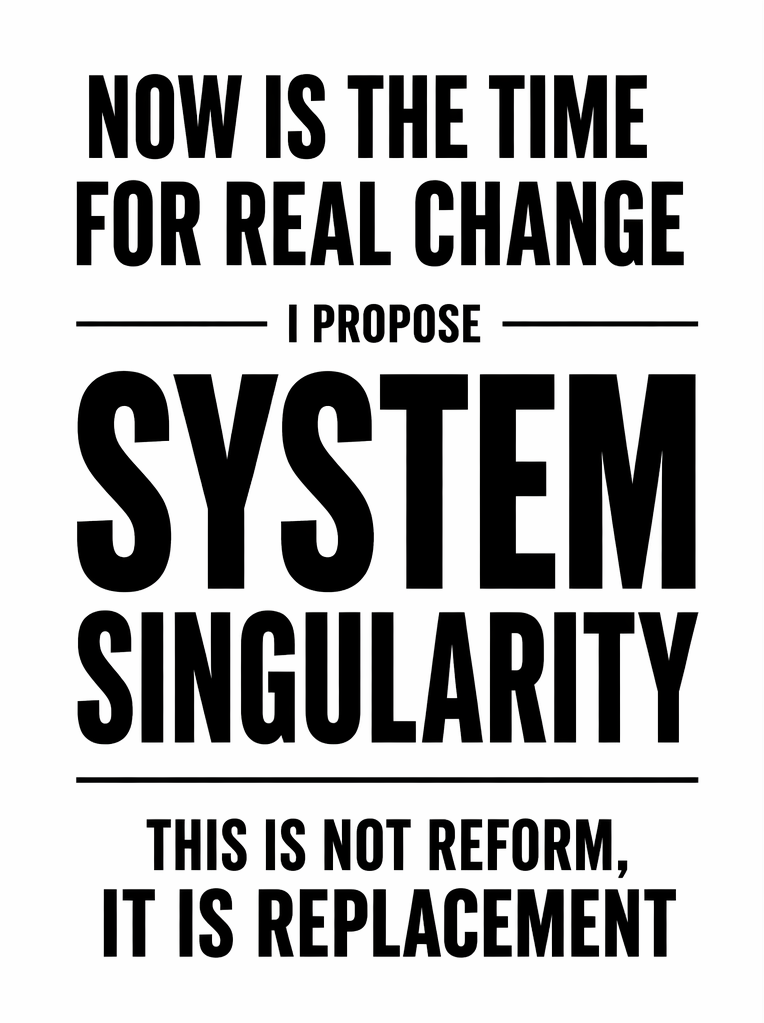
By definition, a System singularity is not a standard formal term with one single definition, but it is used in systems thinking, complexity theory, and sometimes political or technological analysis to describe a point at which a system reaches a critical threshold where its normal rules stop working and something fundamentally different emerges. At that point, the system may transform or collapse into a new order. It may reorganize, mutate, or break apart, producing outcomes that can no longer be managed by the assumptions, controls, or institutions that governed the old system.
And so, our System Singularity is not a reform. It is not an adjustment. It is not an attempt to improve what already exists. It is a break. A decisive rupture with systems that have been protected, maintained, and repeatedly justified despite decades of failure. Now these systems are broken.
For more than 40 years, Québec’s core public systems have been managed by layers of leadership, administration, and ideology that have one thing in common: they preserve the system, not its results. They promise change, absorb criticism, increase funding, and deliver the same outcomes. What has allowed this to persist is not complexity. It is protection. What we call stability has become the organized protection of underperformance, defended in the name of fairness and continuity.
This proposal is designed to end that cycle. It does not attempt to fix the system. It removes what has been quietly sustaining its failure. What replaces it is not a better version of the same structure. It is a different target, a different allocation of responsibility, and a different use of funding.
There are three gaping money pits in Québec’s public system. Not cracks. Not inefficiencies.
But canyons of taxpayer money funneled into large, inefficient organizations that are failing to meet the barest of results.
Every adult in Québec knows it. Sees it. Lives everyday life through it. For decades, we have all watched these systems fail, heard promises of reform, and seen those promises dissolve into more spending, more bureaucracy, and more inefficiency. They swallow billions every year, draining our economic future into a depth of incompetence that seems to have no bottom.
Governments of every ideology have done the same thing, year after year, managing the largest budgets in the province without changing the outcome. Doing the same thing over and over again and expecting different results isn’t just naïve. It is systemic failure, and arguably unethical.
I’m talking about three systems everyone depends on, yet no one truly controls:
• Education
• Health
• Transportation
I call them sectors because their reach extends everywhere. Their tentacles stretch across the entire province, touching every region, every institution, every citizen. No part of Québec escapes their influence. What happens inside these systems affects everyone. But their influence does not operate in isolation.
Their tentacles overlap. Each one feeds into the other. Each failure compounds the next. What begins in one sector spreads to the others until the entire system reflects the same dysfunction.
These are no longer three problems. They have become one continuous failure, sustained not by lack of knowledge, but by adherence to ideologies that prioritize protection over results.
At the core is a principle that has gone unchecked: that everyone in the system must be respected and protected, regardless of outcomes.
Unions institutionalized this logic. Their role is to protect members. That is their foundation.
Management, rather than counterbalancing it, has aligned with it. Not out of principle, but out of survival. The result is a closed system where neither side can confront failure without implicating itself.
Citizens live it every day. They wake up to it, move through it, and go to bed knowing nothing has changed. Over time, this does more than frustrate. It erodes confidence, not just in one government, but in leadership itself, regardless of ideology
Québec is not alone. Many democracies now confuse respect with the refusal to confront failure. In 2025, the scale of failure is undeniable. Québec’s total expenditure budget stands at $130.6 billion in taxpayer money.
Health consumes roughly $70 billion. Education absorbs approximately $33 billion. Transportation commits $10 to $12 billion annually, backed by another $164 billion over ten years.
These are not marginal programs. They are the core of the state’s existence. And yet, all three produce the same outcome: rising costs, declining or stagnant performance, and no accountability that leads to consequences.
This is not underfunding. This is organized inefficiency. We are not managing systems. We are maintaining protected failure.
Money disappears into structures designed to absorb it, justify it, and demand more of it. That money comes from taxpayers today, and from future generations of taxpayers who will pay for the deficits created to sustain the illusion that the system is functioning.
The proposal
As I said earlier, this is not a reform. This is a removal. Each sector will be stripped of the structures, roles, and protections that have allowed failure to continue without consequence.
What replaces them is a clear set of changes with new targets, new assignments of responsibilities, and new conditions for funding.
What comes with my proposal is the nexus of a system singularity.
- No structure survives simply because it exists.
- No sector receives additional funding until it demonstrates results.
- All current leadership will be replaced by new leadership with a mandate to deliver results, not defend inherited failure.
Zone 1 – Education
Target: Teachers teach. Students learn.
Everything that prevents this target from being achieved is removed.
- All leadership is replaced.
- Training and selection are refocused on the ability to manage real classrooms, not theoretical models.
- A binding social contract is imposed: Teachers teach. Parents raise their children. Schools are managed. Unions protect.
Teachers will no longer be left alone to manage disorder created by a system that refuses to assign responsibility. They will be supported to teach not by political ideology, but by the needs of students and the authority of the teaching profession. If a system cannot restore the ability to teach, it is dismantled until it can.
Zone 2 – Health
Target: Quebecers are treated efficiently and competently.
Everything that prevents this is removed.
- Management control is transferred entirely to the medical profession.
- Administrative structures that have governed without accountability are dismantled.
- Funding increases stop until results show efficiency.
Doctors are given full authority over the healthcare system in Québec. With that authority comes full responsibility.
If outcomes do not improve, failure is no longer hidden within the system. It is identifiable, and responsibility is assigned.
Zone 3 – Transportation
Target: Infrastructure works, lasts, and meets standards.
Everything and every current manager is removed.
- A full government performance inquiry examines twenty years of decisions, execution, and outcomes, with a mandate not to investigate criminality, but to identify how systemic inefficiency, failed management practices, and institutional complacency produced enduring failure. All management resources are replaced.
- Funding increases stop until infrastructure quality measurably improves.
Québec will no longer accept a system that builds more than it maintains, repairs more than it prevents, and operates with chronic management, execution, and staffing deficiencies.
The line that changes everything
For decades, governments have protected systems that fail. This proposal protects results. This is not a reformed agenda. It is a structural reset. Each sector is given control. Each sector is given full responsibility. Each sector is given one objective: deliver measurable results.
There is no parallel objective of improvement. Improvement assumes the system is fundamentally sound and only needs refinement. That assumption is false.
These systems have not failed because they lack funding, expertise, or complexity. They have failed because they are protected by people, structures, and habits that preserve inefficiency. That is the core issue.
The individuals and networks that sustain these outcomes are not misaligned assets waiting to be corrected. They are the mechanism of failure. They do not adapt. They do not reform. They protect. And systems protected this way do not improve. They persist.
This proposal recognizes that reality. Where performance is not delivered, the conclusion is not negotiation, retraining, or incremental change. The conclusion is replacement.
Not because of ideology. Because of results. At that point, we stop managing failure… and we remove the conditions that allow it to continue.
AJH